

Focused Executive Intervention



An evidence-led examination of what is actually creating the result — not a consulting program.
Two concentrated days to get underneath a consequential business issue.
I work with leadership, operating information and the people closest to the work to trace the visible problem back to the operating conditions creating it.
Focused means we start with what matters most. It does not mean the investigation is rigid. If the evidence points somewhere else, we follow it as far as the two days responsibly allow.
When the question is consequential — and bounded enough to examine.
The Focused Intervention is designed for established companies where leadership can point to a meaningful symptom, decision or operating condition that can be bounded tightly enough to investigate in two concentrated days.
Do not buy this if.
A Focused Intervention works because the question can be bounded without lowering the standard of evidence.
Then I will tell you.
You are buying an independent examination — not a promise that I will manufacture a finding large enough to justify the engagement.
Knowing what should not change can be as valuable as knowing what should.
Where is your organization carrying the load?
Structural drag appears in six primary shapes. Each points to a different place where the organization is absorbing work its design should resolve. When more than one is active, the pattern itself becomes diagnostic.
When more than one shape fits.
Multiple profiles do not automatically mean the same thing. They may be separate constraints, part of the same causal chain, or evidence that the operating model itself is carrying the load.
What shape did you find?
The place where the problem appears may not be the place creating it.
Visible symptoms often sit downstream from the operating condition producing them. That is why the first explanation is not automatically the right one.

What Would We Find Inside Yours?
Not everything we find gets turned into a dollar number.
Different kinds of evidence mean different things. I separate what has already affected the economics of the business from capacity being consumed inside the operating system — and from consequential exposure that cannot yet be responsibly priced.
Recorded Economic Effect
Financial consequences that have already occurred and can be substantiated from the evidence.
This can include actual margin deterioration, incremental operating cost, rework, leakage or another economic consequence already present in the business.
Consumed Capacity
Paid capacity absorbed by waiting, correction, coordination, reconstruction, recovery or rework.
The capacity matters. But an hour consumed is not automatically an hour of recoverable payroll or cash.
Exposure
A consequential issue where the available evidence does not justify responsible dollar pricing.
It stays visible. It stays important. It stays unpriced until the evidence supports more.
See how I think.
Twelve composite Field Cases show how I trace a visible business problem back to the operating conditions creating it — then separate what is economically proven, what is consuming capacity, and what should remain unpriced.
Operating
Environments
Where margin, capacity, speed and enterprise value are being consumed inside the business.
Post-Sale / Acquisition
Environments
Where the transaction closed.
Now the value has to show up.
The work was profitable.
The handoffs weren’t.
A business can look healthy at the job level while coordination, sequencing and recovery consume the margin between functions.
Utilization looked fine.
Capacity was disappearing.
The issue was not simply how many hours people worked, but how much paid capacity was being consumed by reconstruction, waiting and coordination.
The companies could sell together.
They could not yet decide together.
Cross-entity growth decisions stalled where authority and the economic tradeoff between acquired businesses had never been made explicit.
Your findings.
Your economics.
Your decisions.
The output follows the investigation. A Focused Executive Intervention produces findings from what we actually examine — not from a predetermined report template.
You buy the two days. Then we build the right investigation.
Preparation matters even more when the working window is concentrated. The investigation begins before Day One.
Two days. Five stages. The investigation moves with the evidence.
The work begins before Day One. We arrive prepared to get underneath what matters most rather than spend the first day orienting ourselves to the business.
Enough room to get underneath what matters most.
A Focused Intervention works best when there is a consequential issue that can be concentrated enough to investigate properly in two days.
I lead the diagnosis. I bring in support when the work calls for it.
I personally lead the Executive Intervention — the executive work, the diagnosis, the synthesis and the final judgment.
When the investigation benefits from additional analytical, systems or specialist capability, I bring in the support needed for that work. That may include pre-mapping, data analysis, process reconstruction, evidence organization or technical questions.
Focused Executive Intervention
The current Focused Executive Intervention rate applies through 2026. A 2027 Intervention may be reserved at the current rate while 2026 pricing remains available.

First come, first served.
For $10M to $1B+ companies. If the investment isn’t a rounding error against your revenue, don’t book it.
A concentrated two-day engagement to identify structural drag, clarify what matters most, and get consequential decisions made.
Includes onboarding, pre-mapping, onsite or offsite working sessions, analysis, travel, and a post-engagement action report.
Designed for CEOs, owners, and leadership teams who need to see what is constraining the company — where capacity is trapped, margin is being absorbed, effort isn’t converting, and the structure is making execution harder than it needs to be.
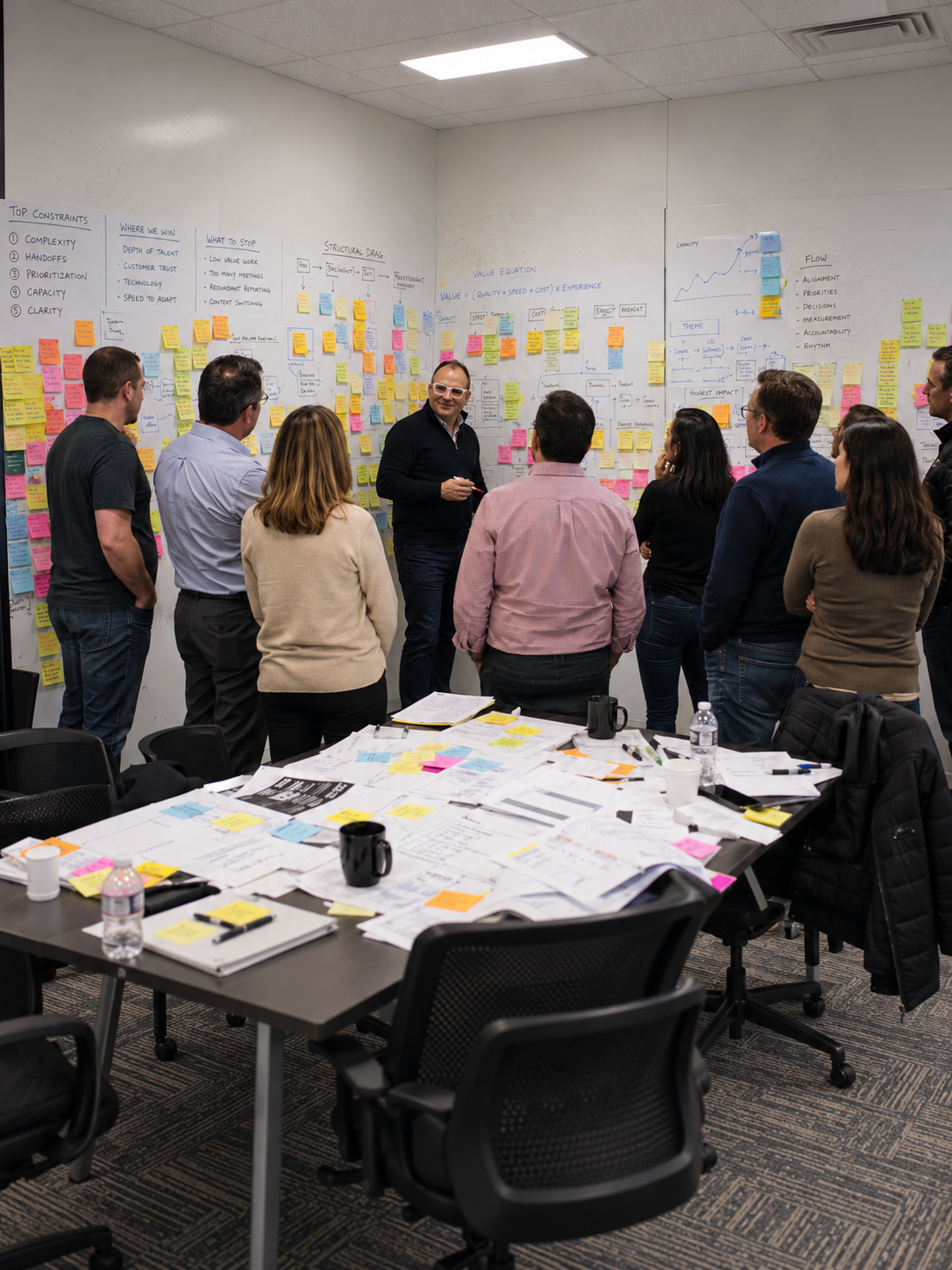
This is not a workshop. We work on the company itself: what is creating the drag, what needs to change, and what decisions can create the greatest movement.
[ ↔️ Compare the 2-Day Focused and 1-Week Comprehensive Interventions →]
You buy the two days. Then we build the right investigation.
Preparation matters even more when the working window is concentrated. The investigation begins before Day One.
Questions worth answering before you commit.
The Focused Executive Intervention uses the same diagnostic discipline as the Comprehensive Intervention, but within a more concentrated field of investigation.
What exactly is a Focused Executive Intervention?
It is a concentrated, evidence-led examination designed to get underneath a consequential business issue in two working days.
It is not a workshop, motivational offsite, generic consulting program, cost-cutting exercise or abbreviated enterprise audit.
I work with leadership, operating information and the people closest to the work to trace the visible problem back to the operating conditions creating it.
Focused means we start with what matters most. It does not mean the investigation is rigid.
How is the 2-Day different from the 1-Week Comprehensive Intervention?
The difference is the amount of room available for the investigation.
The Focused Intervention is designed for an issue that can be concentrated enough to examine properly in two days.
The Comprehensive Intervention gives the investigation more room to move across functions, operating systems, locations, acquisitions or several apparently separate symptoms when the evidence requires it.
The 2-Day is not the cheaper version of the 1-Week. It is the right instrument when the investigation can be concentrated.
Will you assess our entire company in two days?
No.
The value of the Focused Intervention comes from concentrating diagnostic attention where it matters most rather than pretending an entire company can be examined in two days.
That may mean examining a decision path, operating issue, critical handoff, margin problem, capacity constraint, customer or service segment, or a specific acquisition issue.
The objective is not to cover more. It is to get the cause right.
How is the scope determined?
Scope development begins after purchase.
During onboarding, we establish the consequential issue, operating context, available evidence and starting point for the investigation.
Relevant financial, operating and organizational information may be reviewed in advance so Day One is used for investigation rather than basic orientation.
The initial scope gives us a disciplined place to begin. It does not prevent the investigation from following better evidence.
Can the investigation change direction during the two days?
Yes. That is intentional.
If the evidence shows that the visible problem is being created somewhere different from where we started, I do not keep examining the wrong thing simply because it appeared in the initial plan.
The questions, people and evidence we follow can change as the investigation develops.
The field is focused. The investigation is allowed to learn.
Why is the investment fixed if the investigation can change?
Because you are buying a defined period of concentrated senior diagnostic work, not a menu of individual consulting tasks billed by the hour.
Different issues require different investigative paths. Trying to pre-price every interview, dataset, workflow or analytical question would reward adherence to a checklist rather than following the evidence.
The commercial structure is deliberately simple: two days, fixed investment, tailored scope.
What happens before Day One?
The work begins before the formal two-day intervention.
We confirm logistics, identify the people and information likely to matter, gather relevant material, establish the starting point and begin pre-mapping.
Depending on the investigation, advance review may include financial and operating information, organizational structure, decision ownership, customer or product economics, workflow information, capacity information or relevant acquisition materials.
Two days is too valuable to spend learning things we could have learned before we began.
What actually happens during the two days?
The mix follows the evidence.
The work may include executive working sessions, leadership interviews, operating-data review, financial analysis, decision tracing, workflow examination, customer or product economics, capacity analysis or process reconstruction.
Some issues require more time with leadership. Others require getting closer to the work itself.
I am trying to understand the operating mechanism well enough that the conclusion survives scrutiny.
What kinds of problems are a good fit for the Focused Intervention?
The Focused Intervention works best when there is a consequential issue important enough to examine properly and concentrated enough to investigate within two working days.
Examples can include:
- A margin change leadership cannot fully explain
- A decision path that keeps escalating or slowing
- A critical handoff creating delay, rework or coordination
- Added people or resources that are not creating expected capacity
- A customer, product or service segment consuming disproportionate effort
- A specific post-acquisition value-creation issue
- An operating problem where leadership sees the symptom but does not trust the explanation
The deciding factor is not company size. It is whether the issue can be responsibly examined in two concentrated days.
What if the problem turns out to be larger than the 2-Day scope?
Then I will tell you.
I will not pretend that a broader structural condition has been fully examined simply because the two working days have ended.
The intervention may establish enough of the mechanism to act, identify a specific next question, or show that broader investigation is warranted.
The limit of the engagement does not lower the standard of the conclusion.
Who actually conducts the Intervention?
I personally lead the Executive Intervention — the executive work, diagnosis, synthesis and final judgment.
I personally own the questions we pursue, executive working sessions, what deserves deeper examination, testing competing explanations, the final synthesis and the conclusions presented to leadership.
When the work benefits from additional analytical, systems or specialist capability, I bring in the support needed for that work.
You are not buying a methodology handed to a junior team. You are buying my judgment.
What if we already know what we think the problem is?
Most leadership teams already have a theory.
It may be right, partly right, or the place where the problem appears may not be the place creating it.
A margin problem can begin in how work is sold. A capacity problem can begin in how resources become usable. A leadership problem can be created by decision routing. A service problem can be created long before delivery reaches the customer.
A plausible explanation is not yet a finding. It has to survive the operating evidence and economics of the business.
How do you decide what counts as a finding?
A finding has to survive the evidence.
I do not turn every observation into a problem, and I do not manufacture significance to justify the engagement.
Something that looks inefficient may be an economically sensible tradeoff. A suspected structural problem may not survive scrutiny. An area leadership is worried about may actually be working well.
A finding belongs in the conclusion only when the evidence supports it.
How do you quantify what you find?
I separate different kinds of evidence rather than combining unlike things into one large theoretical ROI number.
I do not add unlike ledgers together simply to produce a larger number.
I don't price opportunities that have not happened.
Do you guarantee a return or savings number?
No.
A responsible diagnostic cannot guarantee a predetermined financial finding before examining the company.
Where the evidence supports an economic consequence, I will quantify it. Where it supports consumed capacity, I will identify it as consumed capacity. Where something matters but cannot yet be responsibly priced, I will leave it unpriced.
The standard is evidence, not a target multiple of the fee.
What if you do not find anything significant?
Then I will tell you.
You are buying an independent examination — not a promise that I will manufacture a finding large enough to justify the engagement.
A suspected problem may not survive the evidence. A tradeoff leadership dislikes may be economically rational. An area under scrutiny may be operating better than expected.
Knowing what should not change can be as valuable as knowing what should.
What do we leave with?
The output follows the investigation. You leave with the findings and conclusions supported by what we actually examined.
Depending on what the evidence supports, that may include:
- Priority findings — what deserves leadership attention first
- Operating mechanisms — what is actually creating the result
- Economic findings — what can be responsibly quantified
- Consumed capacity — where paid capacity is being absorbed
- Unresolved exposure — what matters but cannot yet be responsibly priced
- Priority actions — what should change next and why
- What not to change — where the evidence says leave it alone
The field is more concentrated. The standard of evidence is not.
Does the Focused Intervention include implementation?
The Focused Executive Intervention is primarily diagnostic.
Its purpose is to establish what is happening, why it is happening, what the evidence supports economically and what deserves attention next.
The findings provide a basis for what follows, but the intervention itself is not an open-ended implementation engagement.
Diagnosis comes first because implementing the wrong explanation faster is not an improvement.
Can the 2-Day Intervention be conducted onsite or offsite?
Yes. The delivery format follows the work.
Some investigations benefit materially from being inside the operating environment. Others can be examined effectively through executive sessions, operating information and remote analysis.
The appropriate format is determined during preparation based on what we are trying to understand and where the strongest evidence lives.
How do I know whether to choose the 2-Day or the 1-Week?
Choose the Focused Intervention when the issue can be concentrated enough to investigate responsibly within two days.
Choose the Comprehensive Intervention when the issue likely crosses several functions, operating systems, locations, acquired businesses or apparently separate symptoms and the investigation needs more room to follow those connections.
The distinction is not simply two days versus one week. It is how much room the investigation needs.
Start the conversation
or move forward now.
Move forward now.
Tailored scope.
Have a 15-minute
Drag Check.
Just a better conversation.
Compare the
interventions.
Choose the right instrument.