
Structural Simulations
See the Outcome. Before You Make the Move.
The most expensive way to test a decision is to live with the consequences.
Models show how the business works. Simulations pressure-test what could happen when you change it. Compare plausible scenarios across decisions, capacity, flow, margin and value—before committing people and capital.
The Questions Worth Testing
- What improves—and what could break?
- Where would released capacity go?
- Which change creates the most value?
- What happens if we do nothing?
Explore different futures. Expose the assumptions. Choose your move with more confidence.
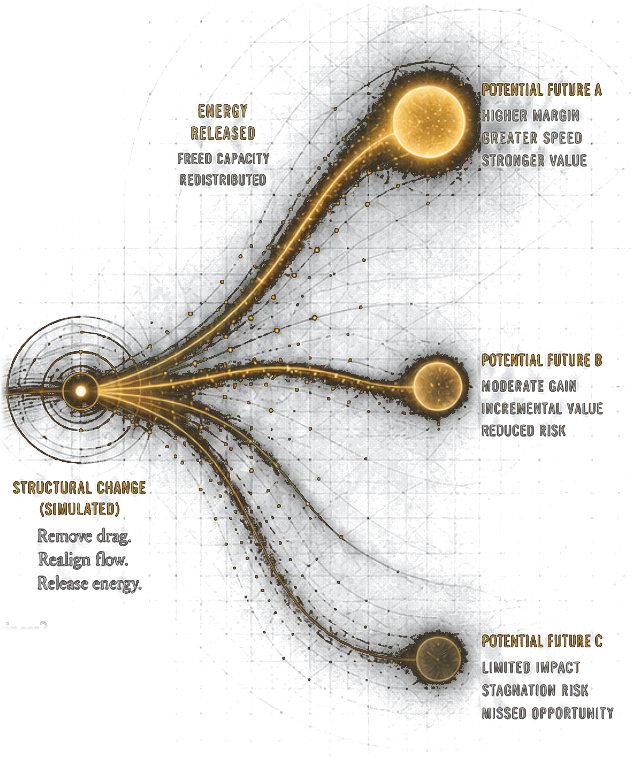
The Value of Structural Simulations
Don't let the live company be the first test.
Restructuring, automation, acquisitions and growth plans put real capital and capacity at risk. A simulation lets you examine plausible consequences and compare alternatives before the business absorbs them.
Second-Order Effects
The change looks right. What else does it change?
A faster approval process can create a delivery bottleneck. A technology investment can free labor but shift work into another function. Test the connected consequences before committing.
Competing Futures
Three possible moves. Different economics.
Compare the proposed move, a credible alternative, and the cost of doing nothing. Model the assumptions, resource demands, and plausible impacts on margin, flow, and value.
Conditions for Success
Know what must be true for the move to work.
The upside may depend on decision rights changing, a handoff improving, or capacity being available in a different place. Make the critical conditions visible before you bet on them.
Before You Commit
The goal isn't to predict the future. It's to make a better decision about it.
Test the assumptions. Compare the scenarios. Identify what deserves to be tried in the real company.


Record sales. A client-reported 30% increase in margins.
Hear directly from seven people across the business—executive leadership, sales, accounting, projects, production, creative and field operations. These are the people who experienced the work.
Select a person to watch their moment
Selected Moment
Seven perspectives. One real company.
Explore more real client outcomes, executive experiences and behind-the-scenes footage of the work itself.
Security Signs reported record sales and an increase in margins in its original customer video. Results are client-reported, not independently verified. This is a real historical engagement.

Executive Interventions
How much of your company exists to compensate for the rest?
A workaround becomes a role. A role becomes payroll. Eventually, the workaround becomes the structure.
In two days or one week, examine what those workarounds may be costing, what they hold together, and which structural changes deserve testing before you commit.
Compare the Interventions