
FOR OWNERS & CEOs OF $10M–$1B+ COMPANIES
Your company is growing. Why is it getting harder to run?
More approvals. More handoffs. More decisions returning to the same people.
More revenue should not require progressively more effort to produce it. Some of that weight is necessary. Some is the cost of growth. And some is structural drag— built into how the company decides, coordinates, commits and delivers.
The work is knowing the difference.
Find what the evidence supports. Decide what should change—and what should not.


02 / Real Client Results
See what changes inside a real company.
The problem is familiar: growth brings more decisions, more coordination and more strain on the operation. The important question is what changes when leaders address the structure instead of simply asking people to work harder.
At Security Signs: record sales and a customer-reported 30% margin increase.
WATCH THE SECURITY SIGNS STORY →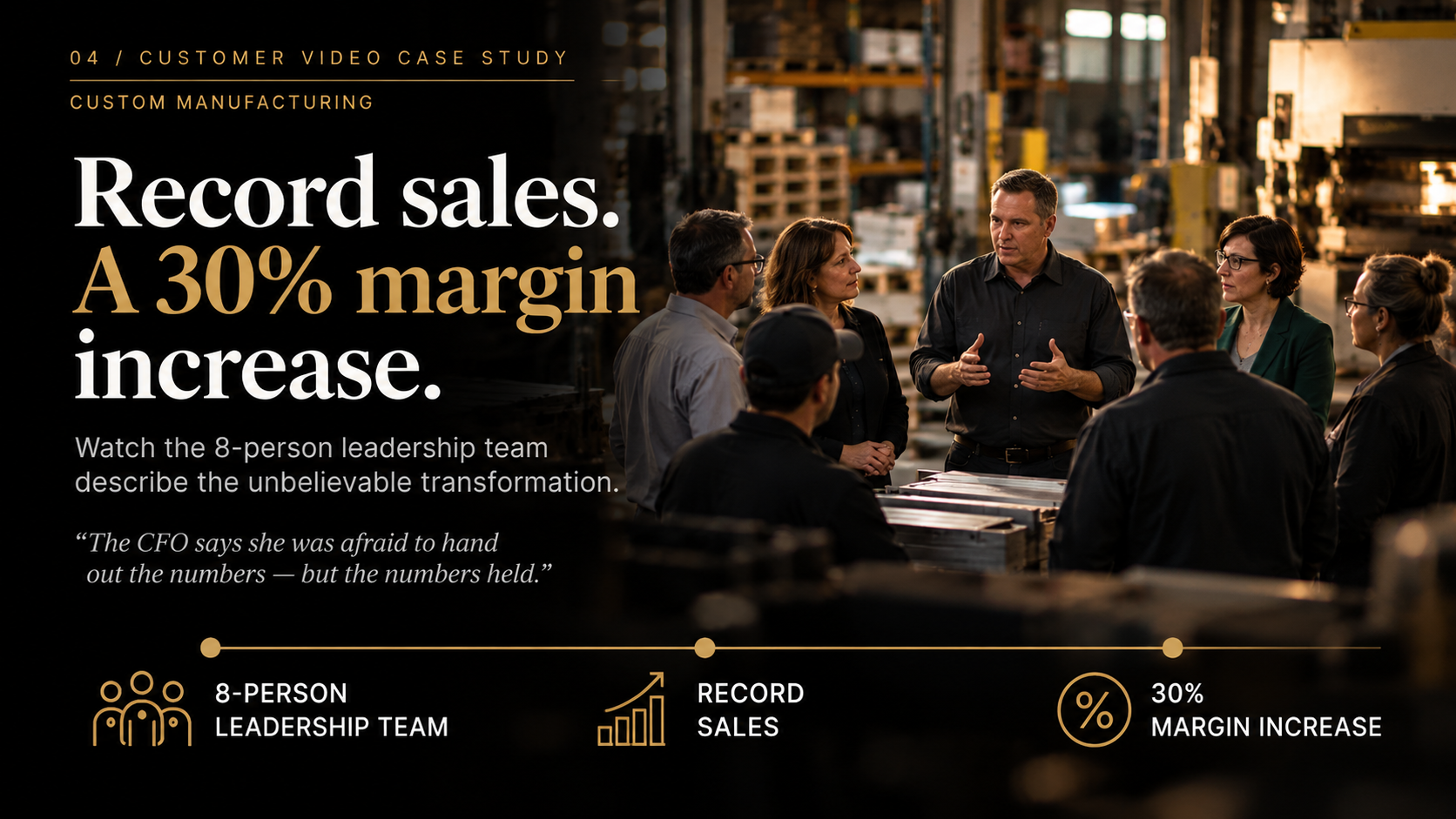
Security Signs · Customer Video Case Study #04 · Customer-reported results
03 / The Six Shapes of Organizational Structural Drag
Where does the work get stuck?
The company can be busy everywhere and still have its capacity trapped in a few recurring places.
Structural drag doesn't always look like waste. It can look like a reasonable approval, a productive manager, a completed handoff, or a commitment everyone agreed to. The question is where the work stops moving.
Decisions keep climbing to the top.
Work waits for senior leaders to approve decisions that other people may already have enough information to make.
Management becomes the work.
Managers spend increasing time coordinating, translating and reconciling instead of moving outcomes forward.
Each team finishes. The work still waits.
Functions complete their own responsibilities, but work stalls where definitions, decisions and handoffs meet.
The customer moves faster than the company.
Requests, changes and exceptions reach the front line faster than the organization's authority or systems can respond.
Commitments outrun readiness.
Dates, capacity or customer promises become commitments before the conditions needed to deliver them are established.
Everything depends on one person.
Critical judgment, knowledge or authority concentrates in an individual. When that person is unavailable, the work waits.
More than one shape can exist inside the same company.
Explore the six profiles, recognize the situations that fit, and see illustrative Field Cases and management tests. A familiar symptom is a starting point, not a diagnosis.
04 / Business Structural Drag Field Cases
A shape tells you where to look. A Field Case shows you what to test.
The problem you can see is not always the condition creating it.
Twelve detailed, fictional composite companies show how operating problems can be investigated across industries, functions and ownership situations. Each explores an operating mechanism, relevant evidence, alternative explanations and a management test.
Everyone did their job. The truck still shouldn't have left.
The Possible Mechanism Sales, production and dispatch each define readiness differently. No one owns the combined promise. The Management Test Before release, can every required party demonstrate the same readiness? READ FIELD CASE 01 FIELD CASE 07 / AGENCY & MARKETING SERVICESThey kept the client. They lost the economics.
The Possible Mechanism Client changes increase delivery work without corresponding fee, scope or priority decisions. The Management Test When the work changes, who can revise the commercial or operating promise? READ FIELD CASE 07 FIELD CASE 11 / TRANSPORTATION & LOGISTICSThey bought an integrated platform. They didn't build one.
The Possible Mechanism Cross-company opportunities depend on trade-offs without agreed group economics or decision authority. The Management Test Who can authorize the best group-level outcome when divisions bear different costs? READ FIELD CASE 11Eight operating companies. Four ownership and acquisition situations. Twelve ways to examine what is really happening.
Explore the complete library, select the situations that resemble your business, and compare the mechanisms and tests that could change a management decision.
All twelve Field Cases are fictional composites created to illustrate operating mechanisms and investigative methods. They are not actual client engagements, verified client outcomes or promises of recoverable savings.
Find the structural drag inside your business.
In a few minutes, see where load is building, what it may be costing, and where leadership should look first.
Find the load. Price the drag. Decide what changes.
High Structural Drag
A meaningful operating load is affecting performance across the business.

Executive Interventions
When the company gets harder to run than it should be.
Some problems are not isolated. They are built into how the company decides, coordinates, and executes.
I work with owners, CEOs, and leadership teams to identify what is creating structural drag, separate signal from noise, and establish what the evidence supports.
Through a 2-Day Focused or 1-Week Comprehensive Executive Intervention, we examine the operating decisions, relationships, and economics behind the problem.
The objective is not simply to find something to fix. It is to determine what should change, what should be protected, and what deserves to happen next.
TAKE YOUR DRAG SCORE →