


You’re losing 30% of your revenue and calling it operations.
Not through one massive failure. Through hundreds of small leaks — absorbing margin, capacity, and enterprise value before any of it reaches you.
A 2-point margin leak on a $20 million company is $400,000 a year.
Over five years: $2 million in cash that never reached you.
Then you go to sell. The buyer prices that same leak at a 5x multiple: another $2 million off your number.
One leak. Two points. A $4 million problem.
Now run the same two points at your lighter competitor.
They don’t leak it. They deploy it — $400,000 a year into faster turnaround, better people, sharper pricing, and AI that compounds all three.
Same two points. You bleed them. They invest them.
That’s not a gap. That’s a transfer.
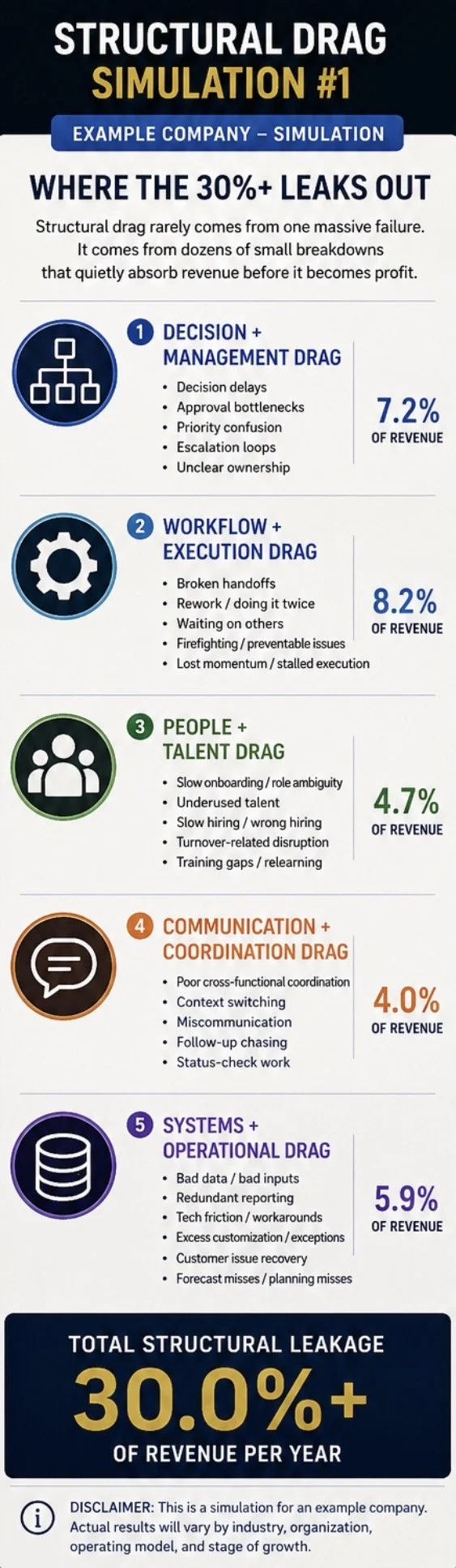
Now look at a simulation of what thirty leaks do.
One leak is a problem. Thirty is a business model — your competitor’s
Thirty leaks. Five years. Run your row.
Structural drag is cumulative. Most organizations aren’t losing value through one major issue — they’re losing it through dozens of recurring leaks compounding across the operating system every day.
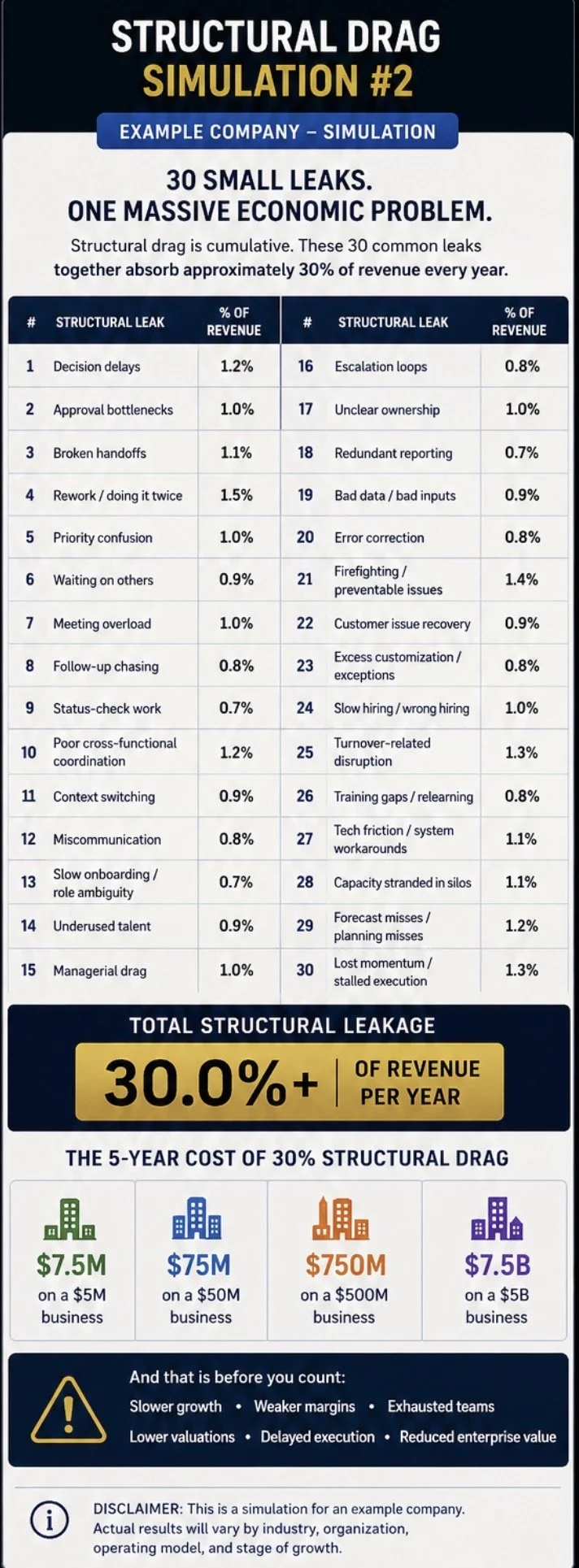
This simulation models 30 common forms of structural leakage that together absorb roughly 30% of revenue annually.
Over five years, that compounds into:
$7.5M on a $5M business
$75M on a $50M business
$750M on a $500M business
$7.5B on a $5B business
And that’s before the parts no simulation can price — slower growth, weaker margins, exhausted leaders, and a multiple that shrinks every year you carry it.
Thirty percent is not normal inefficiency.
It is a compounding value-destruction event.
More effort won’t fix it. More effort is feeding it.

Just 2–3 lost productive hours per person per day quietly absorbs 25–40% of total operating capacity across an organization.
Most companies attack that with more effort.
More meetings.
More hiring.
More systems.
More reporting.
More pressure.
But effort doesn’t remove structural drag. It increases it — every fix adds coordination, and coordination is where drag lives.
The organizations that scale best aren’t the ones working hardest. They’re the ones preserving more energy as it moves through the system.
Your company doesn’t need more effort.
It needs less drag.

Your competitor automated this nine months ago.
Every month you carry the drag, it eats your margin, shrinks your multiple, and funds the competitor coming for your customers.
It’s not just costing your company. It’s repricing your retirement.